 Signals Unheard
Episode 5 · Parts 1 & 2
The Book of Enoch: Watchers, Giants, and the Book Left Out of the Bible
Coming soon · In production
A book quoted by name in the New Testament, then left out of almost every Bible. The full text survived only in Ethiopia, in Ge'ez, and came back to Europe with a Scottish explorer. In the twentieth century, pieces of it turned up in a cave by the Dead Sea. Our two-part episode reads the story as the text tells it, then the dates, the scholarship, and the theories.
The case file
The claim
Genesis says Enoch "walked with God: and he was not; for God took him." A book under his name says two hundred angels, the Watchers, came down on Mount Hermon, swore an oath together, took human wives, fathered giants and taught forbidden knowledge. Some modern writers say the Watchers were never angels at all.
What the record shows
- It's quoted in the Bible. The Epistle of Jude (verses 14–15) quotes Enoch by name. Tertullian defended the book as scripture; Jerome noted that Jude was "rejected by many" because it quotes Enoch; Augustine thought its claimed antiquity made it suspect.
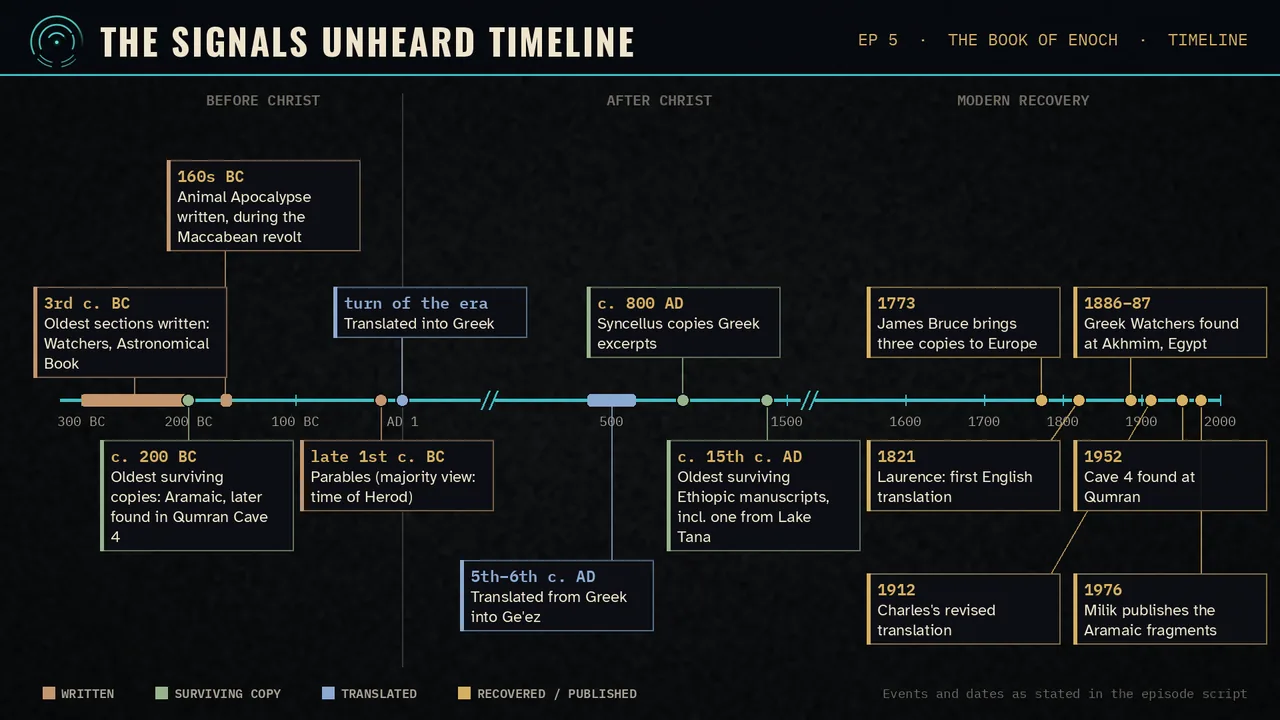
- Five books in one. 1 Enoch is a collection: the Book of the Watchers, the Book of Parables, the Astronomical Book, the Book of Dream Visions (with the Animal Apocalypse) and the Epistle of Enoch.
- It survived complete only in Ethiopia. The full text survives in Ge'ez, and Enoch is canonical scripture in the Ethiopian Orthodox Tewahedo Church. The Scottish explorer James Bruce brought three copies to Europe in 1773; Richard Laurence published the first English translation in 1821, and R. H. Charles's translations followed (1893–1912, and the 1917 SPCK edition we quote).
- The Dead Sea Scrolls. Qumran Cave 4, found in 1952, held pieces of eleven Aramaic copies. The oldest Watchers copy (4Q201) is dated to the first half of the second century BC. The Book of Parables is missing at Qumran and in Greek.
- When it was written. Scholars date the Book of the Watchers and the Astronomical Book to the third century BC and the Animal Apocalypse to the late 160s BC; the majority view places the Parables around the time of Herod. A Greek copy of the Watchers was found at Akhmim, Egypt, in 1886–87.
- The year of 364 days. The Astronomical Book describes a year of exactly 364 days, which falls out of step with the Jerusalem Temple's lunar-solar calendar.
The dates people have calculated
These come from the ages in the texts, not from evidence. Years are counted from creation (Anno Mundi).
| Event | Masoretic Genesis 5 | Septuagint Genesis 5 |
|---|---|---|
| Jared born ("in his days" the Watchers descend) | 460 AM | 960 AM |
| Enoch born | 622 AM | 1122 AM |
| Enoch taken, aged 365 | 987 AM | 1487 AM |
| The Flood | 1656 AM | 2242 AM |
Ways to read it
- Theory · 1968Alien visitorsErich von Däniken: the Watchers were extraterrestrial visitors, and Enoch himself wrote the book (as reported by David Halperin).
- Theory · 1976The AnunnakiZecharia Sitchin, The 12th Planet: the Nephilim were the Anunnaki. His readings are criticised by Michael Heiser and Ronald Fritze.
- Mainstream scholarshipAncient Jewish writingsA collection of Jewish apocalyptic works written over the last three centuries BC under the name of a famous ancient figure, as apocalypses typically were. Some scholars read the Watchers as an inversion of the Mesopotamian apkallu sages.
What the episode covers
Part 1: The Story Final audio
- Cold open
- The man who did not die
- Five books in one
- The oath on Mount Hermon
- Four archangels and a pit in the desert
- The house of crystal and fire
- To the ends of the earth
- The Son of Man
- Three hundred and sixty-four days
- Our take
Part 2: Prophecy, Dates, Theories Storyboard
- Cold open
- Previously
- History as a dream of animals
- Ten weeks to the end of the world
- The child who lit up the house
- Counting the years
- Left out, lost, and found
- Watchers from the stars?
- Older sages, other readers
- Our take
Sources (39)
The research list for this episode. Links go to the original documents, editions and articles.
Primary texts (public domain)
- R. H. Charles, The Book of Enoch (SPCK, 1917; introduction by W. O. E. Oesterley) — gutenberg.org
- Genesis 5 and Hebrews 11:5, King James Version — bible-api.com · bible-api.com
- Genesis 5 in Brenton's English Septuagint (1851) — ellopos.net
- Daniel 7:9–13 and Jude 14–15, King James Version — bible-api.com · bible-api.com
- Jeremiah 25:11 and Daniel 9:24, King James Version
- R. H. Charles, The Book of Jubilees (1913 translation) — axialcommons.org
- George Syncellus, Enoch excerpts (Whiston's 1727 translation), transcribed by Jason Colavito — jasoncolavito.com
- Tertullian, On the Apparel of Women 1.3 — newadvent.org
- Jerome, De viris illustribus 4 — newadvent.org
- Augustine, City of God 15.23 (Dods translation) — newadvent.org
Manuscripts, Qumran and dating
- Wikipedia, "Book of Enoch" — en.wikipedia.org
- Wikipedia, "Qumran Caves" — en.wikipedia.org
- Eshbal Ratson, "4Q208: A New Reconstruction and Its Implications on the Evolution of the Astronomical Book," Revue de Qumrân (2019) — poj.peeters-leuven.be · academia.edu
- Wikipedia, "4Q201" — en.wikipedia.org
- Wikipedia, "Józef Milik" — en.wikipedia.org
- Enoch Seminar, "Camaldoli 2005" — enochseminar.org · eerdmans.com
- Ted M. Erho, "The Ahistorical Nature of 1 Enoch 56:5–8 and Its Ramifications upon the Opinio Communis on the Dating of the Similitudes of Enoch," Journal for the Study of Judaism 40.1 (2009): 23–54 — doi.org
- Philip F. Esler, "Taking 1 Enoch Seriously," The Bible and Interpretation (2018) — bibleinterp.arizona.edu
- Wikipedia pages on the sub-books: "Book of the Watchers", "Book of Parables", "Astronomical Book", "Book of Dream Visions", "Animal Apocalypse", "Apocalypse of Weeks", "Epistle of Enoch"
- Wikipedia, "Enoch calendar" — en.wikipedia.org
- Klaus Koch, "Sabbatstruktur der Geschichte" (1983)
Calculated chronologies
- Wikipedia, "Anno Mundi" — en.wikipedia.org
- Wikipedia, "Ussher chronology" — en.wikipedia.org
- Wikipedia, "Jared (biblical figure)", "Methuselah" and "Genealogies of Genesis"
Theories and further background
- David Halperin, "'Chariots of the Gods?' – Erich von Däniken and the Book of Enoch" (9 February 2018) — davidhalperin.net
- Wikipedia, "Erich von Däniken" and "2 Enoch"
- Wikipedia, "Zecharia Sitchin" — en.wikipedia.org
- Wikipedia, "Mount Hermon" and "33rd parallel north"
- National Geographic, "Find Out How the Giant Skeleton Hoax Started." — nationalgeographic.com · snopes.com
- Wikipedia, "Nephilim"
- Amar Annus, "On the Origin of Watchers," Journal for the Study of the Pseudepigrapha 19.4 (2010): 277–320 — doi.org
- Wikipedia, "Apkallu" and "Generations of Adam"
- George W. E. Nickelsburg, "Apocalyptic and Myth in 1 Enoch 6–11," Journal of Biblical Literature 96.3 (1977): 383–405 — scholarlypublishingcollective.org
- Wikipedia, "Book of Giants" — en.wikipedia.org
- Wikipedia, "Enochian" — en.wikipedia.org
- Wikipedia, "Azazel" and "Dudael"
- Wikipedia, "Ethiopian Orthodox Tewahedo biblical canon"
- Wikipedia, "James Bruce"
- Wikipedia, "Son of man (Judaism)"
Related case files
 Out nowNuremberg 1561: The Battle in the Sky
 In developmentEzekiel's Wheel
 Re-edit in progressShag Harbour, 1967: It Sank. No Results.
Hear it first
Subscribe on YouTube and we'll ring the bell when this one goes up.